For centuries, humanity has been captivated by the concept of a universal formula for beauty—a hidden code that dictates why certain forms, faces, and works of art are perceived as aesthetically pleasing. At the heart of this quest lies the Golden Ratio, a mathematical principle that has been hailed as the secret to perfect proportions. From the majestic Parthenon in Athens to the enigmatic smile of the Mona Lisa, this intriguing ratio, often denoted by the Greek letter phi (Φ), appears with remarkable frequency. But does this "divine proportion" truly hold the key to human beauty, or is it merely a fascinating mathematical coincidence? This article delves into the history, science, and modern application of the golden ratio in our perception of beauty.
What is the Golden Ratio?
The Golden Ratio is an irrational number, approximately equal to 1.618. It is derived from a simple geometric relationship: two quantities are in the golden ratio if their ratio is the same as the ratio of their sum to the larger of the two quantities. This concept has fascinated mathematicians, artists, and architects since antiquity. The ancient Greeks were among the first to explore its properties, believing it to be a key to understanding the harmony of the cosmos. During the Renaissance, artists like Leonardo da Vinci were thought to have incorporated the golden ratio into their masterpieces to achieve a sense of balance and naturalism.
Beyond the realm of art, the golden ratio is found throughout the natural world, from the spiral arrangement of seeds in a sunflower to the elegant chambers of a nautilus shell. This prevalence in nature has led many to believe that our brains are somehow hardwired to appreciate proportions that conform to this mathematical ideal.
The Golden Ratio in the Human Face
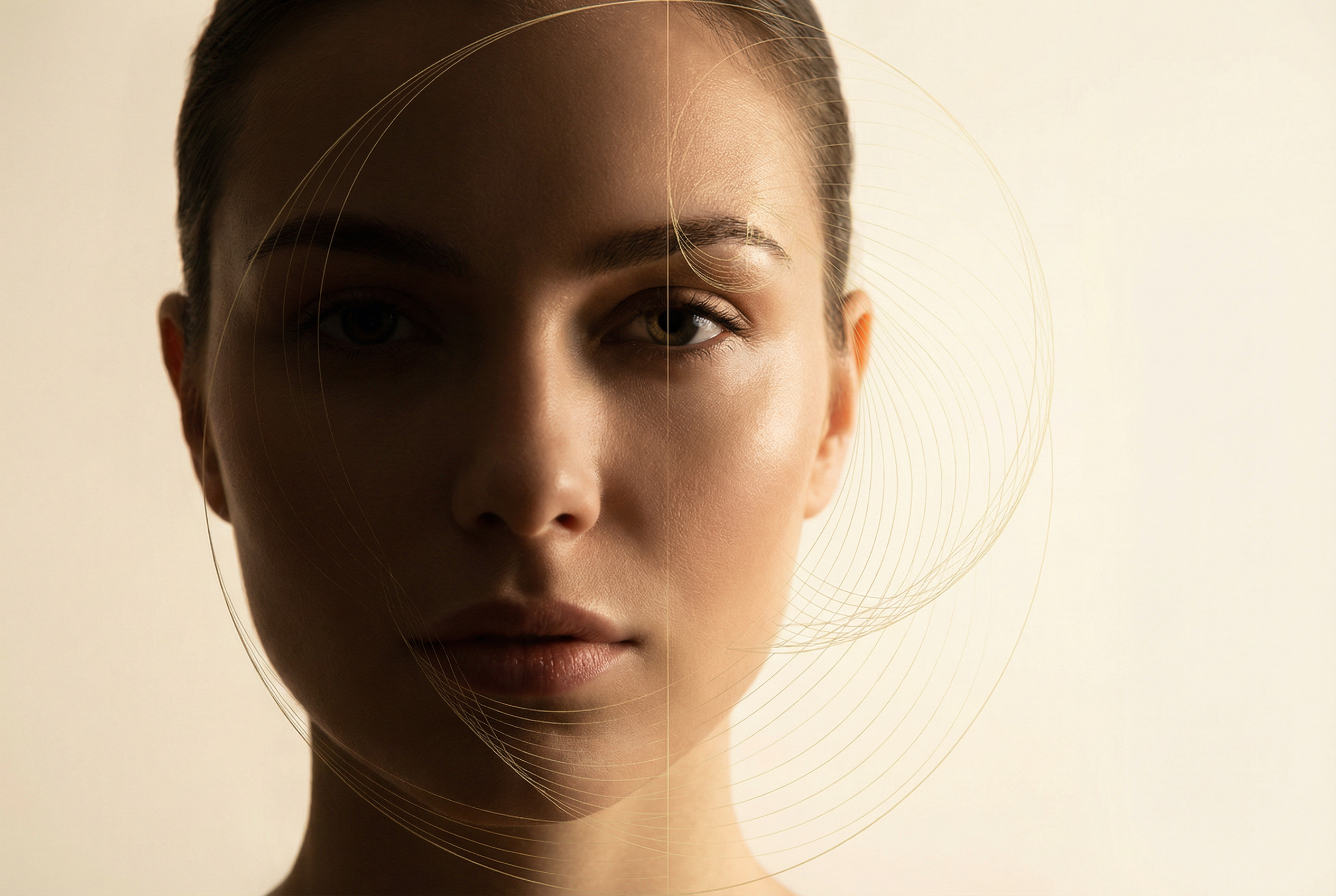
The application of the golden ratio to the human face is perhaps its most captivating and controversial use. The theory suggests that a "perfect" face would exhibit proportions that align with phi. For instance, the ratio of the length of the face to its width would ideally be 1.618. Other proposed golden ratio measurements include:
- The distance from the top of the head to the chin, divided by the distance from the top of the head to the pupils.
- The distance from the nose tip to the chin, divided by the distance from the nose tip to the lips.
- The width of the mouth in relation to the width of the nose.
One of the most well-known proponents of this theory is Dr. Stephen R. Marquardt, a retired oral and maxillofacial surgeon who created the "Marquardt Beauty Mask." This mask is a geometric template based on the golden ratio that can be overlaid on a photograph of a face to assess its "beauty." While the mask has been widely publicized, it has also drawn criticism for its lack of scientific validation and its basis in a predominantly Eurocentric ideal of beauty, a concept that has been challenged by the evolution of beauty ideals across different cultures and eras.
The Science vs. The Myth
While the idea of a mathematical formula for beauty is alluring, the scientific evidence supporting the golden ratio's role in facial attractiveness is mixed. Some studies have found a correlation between faces that approximate the golden ratio and higher ratings of attractiveness. However, other research has failed to replicate these findings, suggesting that the link may be overstated. In fact, some studies have proposed new "golden" ratios for facial beauty, indicating that our perception of attractiveness may be more complex than a single mathematical constant.
Modern research into facial attractiveness points to a variety of factors that influence our perception of beauty, including symmetry, averageness, and secondary sexual characteristics. Symmetry, for example, is often taken as an indicator of good health and genetic fitness. The concept of "averageness" suggests that faces that are closer to the population average are often perceived as more attractive. These factors, while related to proportion, are not strictly governed by the golden ratio.
The Golden Ratio in Modern Aesthetics
Despite the ongoing debate, the principles of proportion and harmony, which are at the core of the golden ratio concept, remain fundamental to the field of modern aesthetics. Aesthetic practitioners, including cosmetic surgeons and dermatologists, use a deep understanding of facial anatomy and proportions to create natural-looking results for their patients. While they may not be explicitly calculating phi, they are guided by the same principles of balance and harmony that the golden ratio embodies.
For instance, when using dermal fillers, a practitioner will carefully consider the overall proportions of the face to ensure that any enhancement appears balanced and harmonious. The goal is not to create a "perfect" face based on a rigid template, but rather to enhance the individual's unique features in a way that is aesthetically pleasing.
| Facial Analysis Method | Description | Pros | Cons |
|---|---|---|---|
| The Golden Ratio Mask | A geometric template based on the golden ratio (1.618) used to assess facial proportions. | Provides a simple, quantifiable measure of facial harmony. | Lacks scientific validation and is based on a narrow, Eurocentric ideal of beauty. |
| Facial Symmetry Analysis | Computer-aided assessment of the degree of symmetry between the left and right sides of the face. | Symmetry is a scientifically recognized indicator of attractiveness. | Perfect symmetry can appear unnatural; some degree of asymmetry is normal. |
| The "Rule of Thirds" and "Fifths" | Divides the face into horizontal thirds and vertical fifths to assess balance and proportion. | A widely used and practical method for facial analysis in aesthetics. | A guideline rather than a strict rule; does not account for ethnic variations. |
| Holistic Assessment | A comprehensive evaluation of the face that considers not only proportions but also skin quality, texture, and individual features. | A more personalized and nuanced approach to facial aesthetics. | Relies heavily on the practitioner's artistic eye and experience. |
Beyond the Numbers: Cultural and Individual Beauty
Ultimately, the pursuit of a single, universal formula for beauty is likely a futile endeavor. Beauty is a deeply personal and culturally contingent concept. What is considered beautiful in one culture may not be in another, and standards of beauty are constantly evolving. The French, for example, have a unique approach to beauty, often described as a certain je ne sais quoi that transcends mere physical appearance, a philosophy explored in the concept of French beauty philosophy.
While the golden ratio provides a fascinating lens through which to view the world, it is important to remember that it is just one piece of a much larger and more complex puzzle. True beauty lies not in a rigid set of mathematical proportions, but in the unique and harmonious interplay of an individual's features, their personality, and their inner radiance.
Frequently Asked Questions (FAQ)
What is the golden ratio face?
A "golden ratio face" is a face that exhibits proportions that align with the golden ratio (approximately 1.618). The theory suggests that the closer a face is to these proportions, the more beautiful it will be perceived.
Can I measure my own face with the golden ratio?
There are many online tools and apps that claim to be able to measure your face against the golden ratio. However, these should be taken with a grain of salt, as the scientific validity of this method is still debated.
Do celebrities have golden ratio faces?
Many articles and websites claim that celebrities like Bella Hadid and Amber Heard have faces that closely match the golden ratio. However, these claims are often based on informal analysis and should not be considered scientific proof.
Is the golden ratio the only factor in beauty?
No, the golden ratio is not the only factor in beauty. Scientific research suggests that other factors, such as symmetry, averageness, and secondary sexual characteristics, also play a significant role in our perception of attractiveness.
How can I improve my facial proportions?
If you are concerned about your facial proportions, there are a variety of aesthetic treatments available that can help to enhance your natural features and create a more balanced and harmonious appearance. Consulting with a qualified aesthetic practitioner is the best way to explore your options.